


If you’ve tried EVERY diet under the sun and still feel stuck, exhausted, or terrified to eat more — this post is for you.
Most women don’t actually have a willpower problem. They have a metabolism health problem created by years of low‑calorie dieting that no one ever explained.
Let’s talk about why.
Why Most Women Start a Calorie Deficit in the First Place
Most of us diet for one simple reason: fat loss.
That might look like:
- Weight Watchers
- Whole30
- Noom
- Optavia
- Keto or low‑carb
- Intermittent fasting
- Eating “clean”
- Dropping calories to 1200 because Dr. Google said so
Different methods — same outcome.
Every one of these approaches creates a calorie deficit, which can lead to short‑term weight loss when done properly.
The problem isn’t the deficit itself.
The problem is how extreme it is, how long it lasts, and what happens after.
Why Cutting Carbs or Fat “Works” (But Isn’t the Real Reason)
When you cut:
- Carbs
- Fat
- Sugar
- Entire food groups
You automatically reduce calories.
That’s why weight loss happens at first, not because carbs or fat were the problem, but because total energy intake dropped.
This is why tracking macros matters. Balanced macros protect:
- Energy
- Hormones
- Muscle mass
- Metabolism health
When you remove entire food groups instead of adjusting macros strategically, you’re setting yourself up for imbalance and burnout.
What Actually Happens During Long‑Term Low‑Calorie Dieting
Picture a road.
On the left:
You’re eating ~2000 calories. You’re energized, motivated, hopeful.
On the right:
You’re deep into dieting at ~1200 calories. You’re tired, burnt out, frustrated, and stuck in a fat loss plateau.
Here’s what changed:
Your metabolism adapted.
Metabolic Adaptation Explained Simply
Your body’s job is survival.
When food intake drops for too long, your metabolism slows to match the amount of fuel coming in.
Meanwhile:
- You’re still working
- Still parenting
- Still training
- Still living life
Energy output stays high. Fuel intake drops.
So your body responds by:
- Slowing metabolism
- Lowering energy
- Disrupting sleep and hormones
- Reducing fat loss efficiency
Eventually, 1200 calories becomes your new maintenance.
That’s metabolic adaptation.
The Two Paths Most Dieters Take (And Why Both Backfire)
When fat loss stalls, most women do one of two things:
Option 1: Cut calories even more
- 1200 → 900 calories
- More fatigue
- More food obsession
- More binge eating
- Less progress
Option 2: Quit dieting entirely
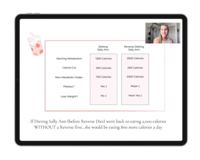
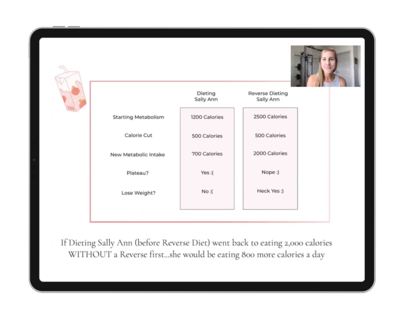
- Jump back to 2000 calories
- Metabolism still stuck at 1200
- Weight regain feels “inevitable”
Neither option fixes the root problem.
The Third Option No One Teaches You
This is where reverse dieting comes in.
Instead of staying stuck in a low‑calorie space or rebounding into weight regain, a reverse diet helps you:
- Heal metabolic damage
- Gradually increase calories
- Restore metabolism health
- Eat more without fat gain
This is the step most women skip — and the exact reason fat loss never sticks.
If you want to figure out where your metabolism currently sits, this is where tools like the Heal Your Metabolism Starter Kit or a properly built macro setup matter.
Why This Matters for Sustainable Fat Loss
True sustainable results don’t come from:
- Eating less forever
- Avoiding carbs
- Living in fear of food
They come from:
- Restoring metabolism health
- Learning how to reverse diet
- Using macro tracking strategically
- Creating a body that can actually lose fat again
I dive deeper into how reverse dieting works in “How is a Reverse Diet Different Than a Calorie Surplus”.
Those conversations pair perfectly with this episode.
What’s Coming Next
This was Part 1.
Next week, we’ll dive into:
- Reverse Dieting 101
- How to increase calories without gaining fat
- Why eating more can actually support weight loss
If you’ve been stuck in a fat loss plateau and know deep down that restriction isn’t the answer, you’re exactly where you need to be.AND if you want to skip the free stuff and get right to the educated and expert support so you can end the food guilt, low energy, and binge/restrict, feel free to peek at our BPM Metabolism and Fat Loss Coaching!!